
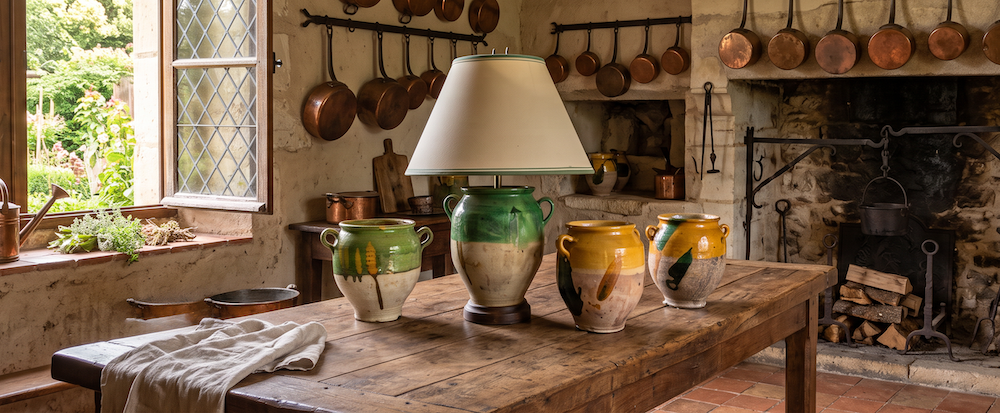
There's a particular kind of object that doesn't announce itself. It sits on a shelf, or a kitchen counter, or a worn wooden table, and simply belongs — as if it arrived before the house did. Nineteenth-century French confit pots are exactly that. Utilitarian in origin, extraordinary in presence. Made to preserve duck and goose in their own rendered fat, they outlasted their purpose and became something rarer: honest objects with a life written into their surfaces.
A Kitchen Essential Born from Necessity
Long before the refrigerator became a fixture of domestic life, the farmhouse kitchens of Gascony, Périgord, and the broader southwest of France had their own system of preservation. Come autumn slaughter season — la tuade — ducks and geese were salted, slow-cooked in their own fat, and sealed into heavy earthenware vessels. These were confit pots, and they were as essential to the French country kitchen as the hearth itself.
The pots were not decorative objects. They were workhorses — stacked in cool cellars, buried in earth, handled daily by farm women whose relationship with them was entirely practical. Which is precisely why the ones that survived are so remarkable. They weren't pampered. They lived hard, useful lives, and the evidence of that life is exactly what makes them beautiful now.
Production was centered in a handful of regional pottery towns, each with its own clay traditions. Apt, in Provence, produced pots with a distinctive marbled slip. Saint-Jean-de-Fos in the Hérault was known for its deep green glazes. Agen, in Lot-et-Garonne, turned out robust, heavily potted forms that could withstand the demands of a working kitchen. The regional variation matters — it's part of what makes collecting these pots endlessly interesting.
How They Were Made: Clay, Wheel, and Fire
The construction of a 19th-century confit pot was entirely hand-thrown on a kick wheel, and you can still feel that in the finished object. Run your fingers along the interior of a genuine example and you'll find the faint horizontal ridging left by the potter's hands — called throwing lines — a tactile record of the making process that no mold-cast reproduction can convincingly fake.
The clay bodies varied by region but were generally coarse-grained and iron-rich, which gave the fired pots their characteristic warmth and weight. Walls were thrown thick — these vessels needed to hold significant mass without cracking under the stress of being moved full of fat and preserved meat. Lips were rolled or pulled outward to allow for the tying of cloth or parchment covers, and many original examples still show the faint groove worn into the rim by years of cord.
After throwing, the pots were left to dry slowly — sometimes for weeks in humid farmhouse conditions — before bisque firing in a wood-fueled kiln. The irregularities introduced at this stage, the very slight lean to one side, the almost imperceptibly uneven base, are hallmarks of authentic hand production.
Glaze Colors and Regional Techniques
The glazes applied to 19th-century French confit pots are one of their most visually arresting features, and one of the most reliable indicators of authenticity. Lead-based glazes were standard through most of the century, producing colors of extraordinary depth — muted ochres, tobacco browns, slate greens, and the occasional burnt sienna that seems to hold light rather than reflect it.
The famous vert de Saintonge — a copper-oxide green particular to the Charente region — ranged from a pale celadon in thinner applications to an almost inky forest green where the glaze pooled at the base. Salt glazing, practiced particularly in Alsace and parts of Burgundy, produced a subtler surface, slightly dimpled in texture, like orange peel, with a translucency that allowed the clay body's color to read through.
Slip decoration was another common technique — liquid clay of contrasting color applied by brush or trailed through a quill to create stripes, spirals, or occasional florals. The Apt tradition of marbled polychrome slip — layers of different-colored clays pulled through one another before glazing — produced pots that look, quite genuinely, like they belong in a museum. Some do.
What Authentic Patina Actually Looks Like
Patina is the word that gets thrown around most carelessly in the antiques world, and with confit pots it's especially important to understand what you're actually looking at. Authentic 19th-century patina on these pieces is not simply dirt or age — it's a record of use, storage, and the specific chemistry of a lead glaze interacting with fat, salt, and time over many decades.
On the exterior, look for a crazing — a fine network of hairline cracks in the glaze surface — that runs consistently across the entire piece, including areas that would have been difficult to access for artificial distressing. Crazing on a genuine old pot has a quality of inevitability to it; it follows the glaze's own logic. Reproductions often show crazing that's too uniform, too dramatic, or suspiciously concentrated on the most visible surfaces.
Interior surfaces of working confit pots frequently show a darkening from absorbed fats, sometimes with a faint waxy quality even after a century of disuse. The base, where the pot rested on an earthen or stone floor, will typically show a distinct wear pattern — not scratches, but a gradual softening of the foot ring, with traces of whatever surface the pot spent its working life on. Grit embedded in the base is not unusual. It is, in its way, wonderful.
Chips and losses to the rim are common and should not trouble you. In fact, an intact rim on a pot that otherwise shows significant age and use is something to investigate rather than celebrate. These were working objects. They got knocked about.
What to Look for When Buying
The market for 19th-century French confit pots has deepened considerably over the past decade, which means both that there are more serious dealers who know their stock and more reproductions designed to catch out the unwary. Approach buying with curiosity rather than anxiety, and these are the things worth examining closely.
Weight and wall thickness first. Authentic pots are heavy — the clay bodies are dense and the walls are substantial. A lightweight pot with thin walls is almost certainly a later, factory-produced piece or an outright reproduction. Hold it in both hands and feel for that solidity.
Examine the base carefully. Machine-made reproductions will often have a tell-tale smoothness on the foot ring, or a perfectly circular base. Genuine hand-thrown pots have bases that are worked, not molded — sometimes with a faint spiral from the wire used to cut them off the wheel, and always with the slight irregularity of human hands rather than industrial process.
The glaze interior matters enormously. Reproductions often apply glaze too evenly — a consistent, bright color from lip to base. On a working pot that was fired vertically in a wood kiln, glaze will have moved. It pools toward the base, thins toward the rim, and may show drips or runs that stopped mid-travel when the kiln cooled. That movement is evidence of an actual firing, not a controlled industrial process.
Ask about provenance where possible, but don't place too much weight on a seller's story. The pot itself is the document. Learn to read it.
The Reproductions Worth Knowing About
The most convincing reproductions in circulation tend to come from two sources: mid-20th-century French studio potters who made deliberate homages to country pottery traditions (these can be lovely objects in their own right, just not antiques), and contemporary pieces produced in Portugal and parts of Eastern Europe for the export market.
The Portuguese pieces in particular have improved dramatically in quality and are now the primary source of confusion at the lower end of the market. They use appropriately coarse clay bodies, apply glaze in period-correct colors, and even introduce deliberate imperfections. What they cannot fake convincingly is the specific quality of lead-glaze crazing — the network is too regular, and under magnification the cracks lack the slight mineral deposit that accumulates in genuine old crazing over decades of exposure to kitchen air. A jeweler's loupe is not an affectation when buying pottery; it is a practical tool.
When in doubt, buy from a dealer who specializes in French country antiques and who will provide a written receipt describing the piece as 19th century. That paper trail matters if you ever want to sell. And if you find one at a brocante for forty euros that makes your hands go still the moment you pick it up — trust that feeling. Years of looking at pots teaches you things no article can entirely convey.
FAQs
What exactly were French confit pots used for?
Confit pots were used primarily in the farmhouse kitchens of southwest France to store confit — meat, typically duck or goose, that had been slowly cooked and preserved in its own rendered fat. The filled pots were sealed and stored in cool cellars or buried in the earth, providing a reliable food supply through winter months before refrigeration existed. Some pots were also used for storing preserved vegetables, dried herbs, and rendered lard.
What are the most valuable types of 19th-century French confit pots?
Value is driven by a combination of regional origin, glaze quality, decoration, and condition. Pots from Apt with their distinctive marbled polychrome slip tend to command the highest prices, as do examples with the deep copper-green glaze associated with the Saintonge region. Unusually large examples — anything over 35 centimeters tall — are relatively rare and desirable. Pots with original slip-trailed decoration, particularly dated or initialed examples, attract serious collector interest.
How do I clean a 19th-century French confit pot without damaging it?
Gently, and with significant restraint. A soft brush to remove loose dust, and if necessary a barely damp cloth — never soaking wet — to address surface grime. Avoid any soap or cleaning agent, which can penetrate the porous, often uncrazed areas of the glaze and alter the appearance permanently. Do not attempt to scrub the interior or remove the darkening from absorbed fats; that patina is part of the object's history and a marker of authenticity. If you're unsure, leave it alone. The pot survived 150 years without your intervention.
Can 19th-century French confit pots be used for food storage today?
This is a question worth taking seriously. Pots produced before the late 19th century were almost universally glazed with lead-based formulations, and while an intact glaze poses minimal risk, any crazing or damage to the glaze surface can allow lead to leach into acidic or fatty foods. For display and decorative use, these pots are entirely safe. For actual food storage or cooking, we'd recommend keeping them as the beautiful objects they are rather than pressing them back into service.
Where are the best places to find authentic examples?
The honest answer is: France, ideally in person. The brocantes and vide-greniers of Gascony, Périgord, and the Languedoc still turn up genuine examples at reasonable prices, particularly if you're willing to look past surface grime. The markets at L'Isle-sur-la-Sorgue in Provence are worth an entire trip. Beyond France, established dealers specializing in French country antiques in the US and UK — those who travel to source their stock personally — are your most reliable option. Online auction platforms carry genuine pieces, but require considerably more due diligence.
How can I tell the difference between a genuine 19th-century pot and a mid-20th-century reproduction?
The most reliable indicators are the quality and character of glaze crazing, the weight and texture of the clay body, and the evidence of genuine use — absorbed fats in the interior, worn foot rings, and rim chips consistent with working life rather than deliberate distressing. Mid-20th-century studio pieces often show a more self-conscious quality to their irregularities, as if the maker was performing rusticity rather than simply making a functional pot. A jeweler's loupe examining the crazing pattern will usually settle the question: genuine lead-glaze crazing from the 19th century shows a mineral deposit in the cracks that cannot be convincingly replicated in a recently made piece.